

For National Defence – Temporary Solidarity Contribution by Banks
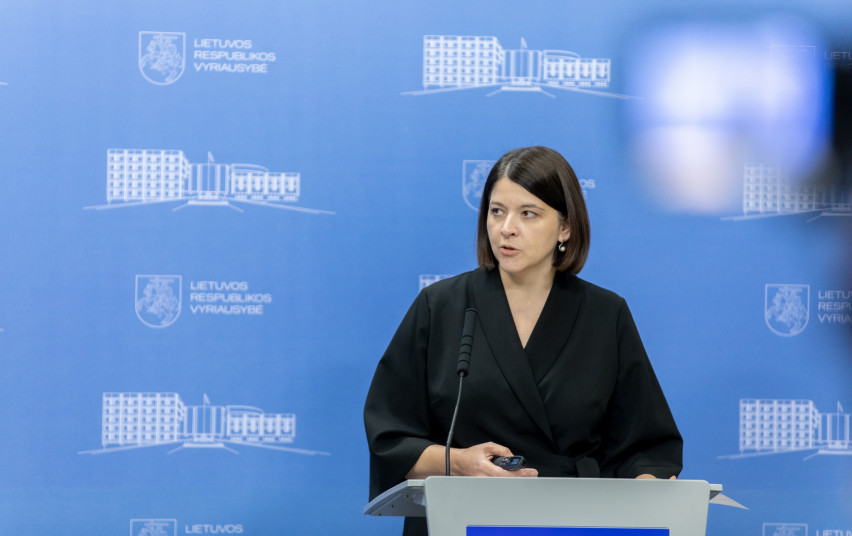
Today, the Government approved the draft Law on Temporary Solidarity Contribution prepared by the Ministry of Finance and the Bank of Lithuania aimed to channel the part of unexpected net interest income of banks to finance military mobility and military transport infrastructure projects.
"Currently, Ukraine is holding the front line for us, but Lithuania also needs to prepare, and prepare faster than it has been done so far. Therefore, our suggestion is to invest the income received during these two years specifically in military mobility and military infrastructure projects. As a result, the temporary solidarity contribution directed only to the part of unexpected net interest income of credit institutions will contribute to the temporarily significantly increased national security needs - military mobility and military transport infrastructure projects, which will ensure Lithuania's capacity to receive allies, expand the capacities of airports and seaports, and reconstruct the roads necessary to military transport, to build military infrastructure," noted Minister of Finance Gintarė Skaistė.
"The improved draft law responds to the concerns of the institutions and market participants that were expressed after presenting the first draft law – it does not include the interest income from new credit, the contribution is applied to the entire sector. The most important principle is maintained in the solidarity contribution model – it is channelled to only unexpected and significant part of excess net interest income and is temporary," says Gediminas Šimkus, Chairman of the Board of the Bank of Lithuania.
The proposed temporary solidarity contributions are expected to generate about EUR 410 million at the time of validity of the law. The war erupted by russia in Ukraine has additionally highlighted the needs for military mobility in Lithuania, which are estimated at EUR 963 million. The temporary solidarity contribution is planned to finance the construction of the bypass necessary for military transport, development and renovation of airports and the seaport, installation of logistics and loading sites, development of national roads at Rūdninkai polygon, reconstruction of the highway at the Polish border, renovation of bridges and viaducts, construction of ramps and the implementation of other necessary projects. The difference between needs and temporary solidarity contributions is to be financed by the European Union assistance.
Several changes have been made in the draft law approved by the Government since the original version. After listening to the proposals received, a clause regarding new crediting agreements is included, with the aim of completely separating new crediting activities from the temporary solidarity contribution, thereby eliminating any doubts that the temporary solidarity contribution may influence the normal activities of credit institutions and the business decisions they make.
The draft law also establishes a safeguard so that net interest income grows at least at an average pace, ensuring the financial stability of credit institutions. As a result, the draft law proposes that the net interest income of the current payment period, excluding interest income from newly concluded credit agreements, after paying the temporary solidarity contribution of that period, should amount to at least net interest income of the year 2022 increased by 15%. If the interest income were lower, the temporary solidarity contribution would be reduced accordingly.
Taking into account the comments by the Competition Council, the temporary solidarity contribution will be applied to all credit institutions, excluding EUR 400 million, i.e. 1% of the deposit limit of all residents, but a coefficient reflecting the share of each credit institution's activity in Lithuania is applied to the base. In this way, it is taken into account that the resulting atypical situation was formed mainly due to economic processes and operations and market imperfections in Lithuania, and not due to business decisions of financial institutions.
During the submission of the draft Law on Temporary Solidarity Contribution, the amendment to the Law on Personal Income Tax was abandoned.
The proposed temporary solidarity contribution is calculated without causing negative consequences for Lithuania's competitiveness, as it would be applied only to the unexpected part of credit institutions' interest income, which is not related to business decisions. Based on the draft law, the temporary solidarity contribution would be paid for the years 2023 and 2024, separating unexpected income from normal income. It is proposed to set impermanently the rate of 60% for the temporary solidarity contribution only on part of the net interest income, which is above more than 50% increase of the average net interest income in four financial years. Thus, the contribution is set so that it would be applied only to credit institutions receiving unplanned income and would be valid for a limited time. In the absence of excess net interest income, the contribution does not apply. In addition, a sufficient income reserve is left to cover possible losses due to loan quality deterioration, increased operational and other expenses.
The need for the temporary solidarity contribution stems from the temporary potential for a significant increase in banks’ profits, mainly due to the economic and geopolitical factors of the past two years and the response to them and not due to businesses decisions. During the outbreak of the coronavirus pandemic, the state allocated the unprecedented support to business and people. This has not only reduced the credit risk of businesses and households as well as the loss potential for banks, but also increased the level of liquidity in the financial system. In Lithuania this led to the fastest growing level of deposits in the euro area — 52 % — and the residents’ deposits accumulated were by EUR 11 billion higher than the loans. The European Central Bank (ECB) significantly increased reference interest rates as a result of the war erupted by russia in Ukraine and a significant increase in inflationary processes. The current excess limits banks’ incentives to raise deposit interest rates, while historically the largest liquidity excess is held by banks mainly in the central bank account. The ECB pays interest to commercial banks on these funds. As a result of the huge and unusual excess of liquid assets in such a situation, this income does not depend on business decisions taken by banks and are therefore regarded as unexpected.
We would like to remind that the draft Law on Temporary Solidarity Contribution is subject to an exception to the rule of the six-month entry into force provided for in the Legislative Framework Law due to exceptional circumstances. These exceptional circumstances were already established in 2022, which were confirmed by the National Audit Office. The proceeds of the temporary solidarity contribution are earmarked for a specific purpose — military mobility and military transport infrastructure projects, since, according to the doctrine of the Constitutional Court, by means of a temporary separate law, in exceptional cases expenditure may only be foreseen to achieve a specific, generally important objective within the period laid down by law.
Lithuania is not the first country in Europe to offer a temporary solidarity tax —regulation that is analogous in substance applies also in other countries, such as Spain, the Czech Republic, which have introduced a temporary solidarity contribution to unexpected income or profits of credit institutions.
Last updated: 07-04-2023
Related news:
Defence bonds were distributed for EUR 47.4 million across recent issues
Minister of Finance: A historic turning point in ILTE activities
Collection of revenue to the State budget and municipal budgets in January-June
The formation of the political team of the Ministry of Finance has been completed