

G. Skaistė: “In reviewing EU fiscal rules, it is important to provide for reasonable flexibility for defence spending”
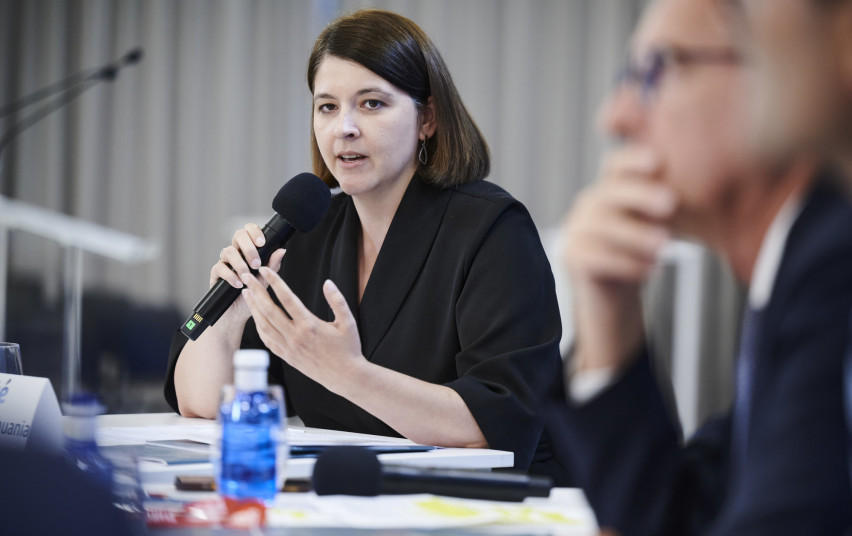
During debate on the revision of the European Union (EU) fiscal rules at the EUROFI Financial Forum in Spain, Minister of Finance Gintarė Skaistė stressed that securing the sustainability of public finances must remain the fundamental objective of the rules, however, there is room to create incentives for reforms and investments enhancing the economic growth potential. The Minister also emphasised the need to consider the changed geopolitical environment and to provide for in the rules reasonable limited flexibility for investments in strengthening defence capabilities.
“russia’s war against Ukraine radically changed the geopolitical situation in the region and in Europe as a whole, as well as led to significantly increased financing needs for security and defence. These needs cannot be postponed to the future, we must invest in strengthening national defence already today. Therefore, when reviewing the EU fiscal rules, we see the need and the possibility of introducing reasonable and limited flexibility for investments in defence capabilities. For example, we believe that such investments, especially not creating continuous obligations, could be treated more flexibly in the context of the 3 % deficit limit”, said the Minister at the Forum.
According to the Minister, the European Commission’s proposal to move towards individual country-specific fiscal targets should be treated as a step in the right direction. This should allow for a better assessment of the economic situation and public finances of individual countries and for setting realistic and achievable fiscal targets accordingly. At the same time, the Minister stressed that such a new model must be based on common, uniformly applied and transparent rules that ensure sustainable debt reduction in high-debt countries and limit debt growth in countries where debt levels are currently low.
The revised fiscal rules should also create incentives to implement structural reforms that enhance the growth potential of the economy rather than investments. Here, it is important to clearly define the criteria to assess the effectiveness of reforms and investments, while ensuring their consistency with debt sustainability objectives.
Finally, the Member States must have enough political freedom of manoeuvre to shape their reforms and investment policies. The option to choose concrete tools to achieve agreed fiscal targets, would strengthen the states’ responsibility and lead to more consistent and effective EU-wide compliance with fiscal rules.
At the panel “Reforming the Stability and Growth Pact: Substantial Problems and Next Steps” of EUROFI Financial Forum in Santiago de Compostela, Spain, Minister of Finance G. Skaistė had discussions with State Secretary at the Ministry of Finance of Germany H. Thoms, Belgian Minister of Finance V. Van Peteghem and Director General of the Treasury of France E. Moulin.
Last updated: 19-09-2023