

Lithuania's economy will grow by 3.1% this year, and growth will continue to be supported by strong domestic demand - rising personal income and investment
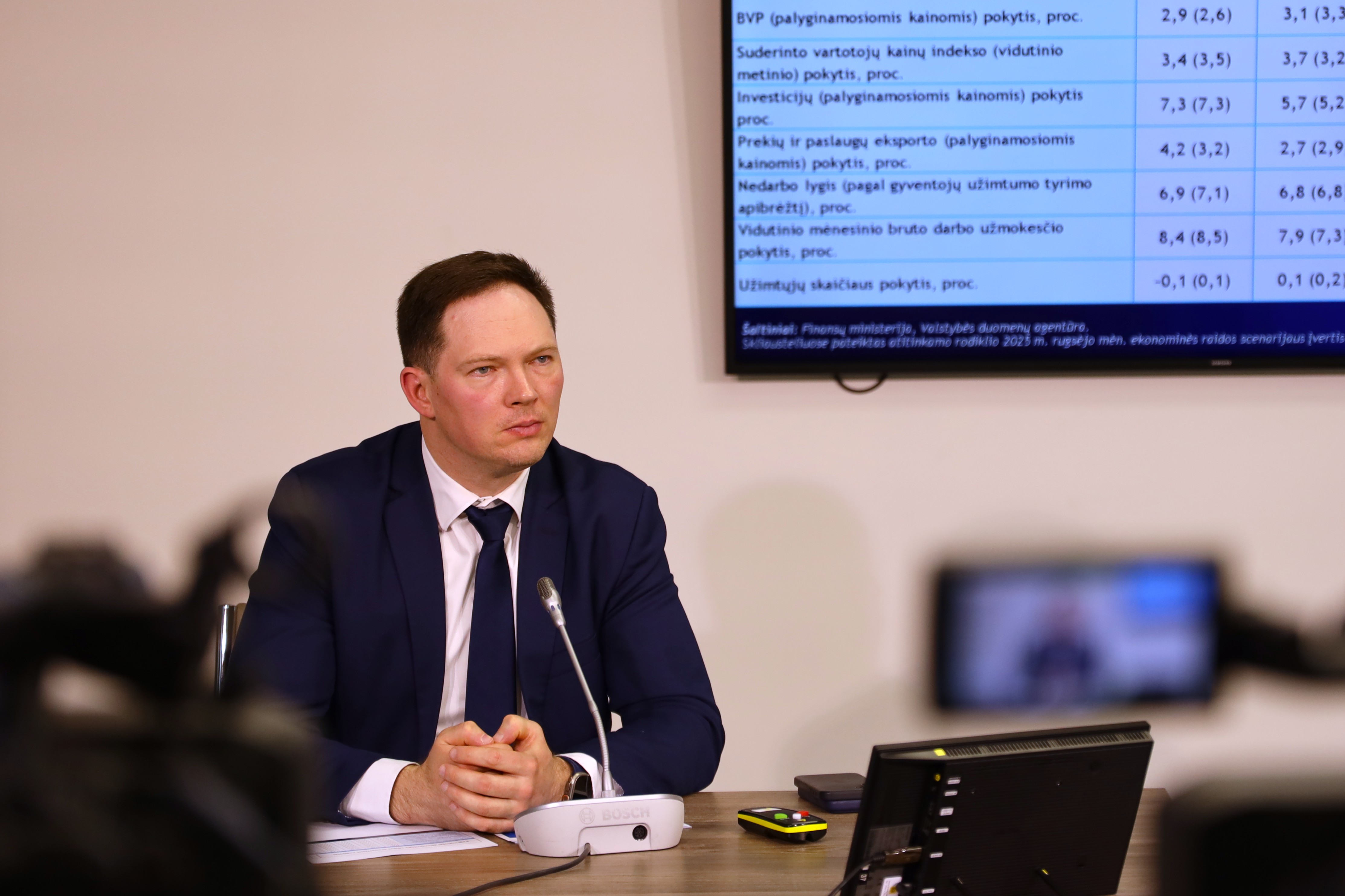
After the economic growth recorded last year, the country's economic expansion is expected to be slightly faster in 2026, reaching 3.1%. Inflation will rise to 3.7% this year. The unemployment rate is set to fall to 6.8% this year, while wage growth is set to remain robust at 7.9%. This is projected in the updated Economic Development Scenario of the Ministry of Finance.
“In the near term, growth will continue to be supported by strong domestic demand, with rising personal income and investment, which will be strongly influenced by budgetary policies. On the other hand, the unfavourable external environment – geopolitical tensions, uncertainty in international trade policy and the slow development of key export partners – remains an important source of risk. However, Lithuania’s economy maintains its growth rate and demonstrates resilience even in the face of heightened uncertainty in the international environment”, Minister of Finance Vaitiekūnas says.
The Economic Development Scenario prepared by the Ministry of Finance projects that, after relatively strong growth last year, in 2026 Lithuania's gross domestic product (GDP) growth will maintain its trend and reach 3.1%, mainly due to the impact of the second pension pillar reform on domestic consumption. Once this impact disappears, growth will slow down to 2.3% in 2027. In the medium term, Lithuania's GDP is expected to grow by an average of 2.7% per year.
With the persisting shortage of suitably skilled workers, the unemployment rate will fall to 6.8% in 2026 but will remain relatively high. The unemployment rate will rise slightly to 6.9% next year, as economic growth slows, and is set to reach 6.8% in the following years of the medium term. The number of employed persons will increase slightly this year, to 0.1%. In the subsequent years of the medium term, the change in employment will remain stable, but close to 0.
The scenario projects that this year's average gross monthly wage growth will remain relatively strong at 7.9%. In 2027, the average monthly gross wage growth rate is expected to reach 6.1%.
Last year, price growth in the country accelerated and was close to the country's multi-year average. In 2026, the average annual inflation rate is expected to be 3.7%. During this period, it will be reinforced by the entry into force of the changes to the funded pension scheme, which will temporarily strengthen domestic demand. Increased energy commodity prices due to events in the Middle East will also exert additional price pressures. In the outer years of the medium term, the inflation rate is expected to slow to 2.4%.
As household income grows, the purchasing power of the population will continue to strengthen. Household consumption expenditure is expected to grow significantly faster this year than in the previous year, by 4.5%. The impact of the reform of the second pension pillar will have an impulse to the acceleration of consumption growth. As these effects fade away, consumption expenditure growth will slow down to 2.2% in 2027 and reach 3% by the end of the medium term.
Expenditure on gross fixed capital formation (GFCF) is expected to grow by 5.7% this year. With the growing need to invest in national security, growing external and domestic demand, and the continued need to invest in measures that increase labour productivity, the average growth rate of expenditure on GFCF could be close to 4.4% between 2027 and 2029.
The scenario foresees that real exports of goods and services are expected to grow by 2.7% in 2026 – slower than last year. The development of export markets and the development of Lithuanian exports of goods will be negatively affected by the formation of a high comparative base, weaker international trade conditions due to US import duties on EU goods and higher energy prices due to the war in Iran. Exports of services will continue to make a significant contribution to overall export growth. In the following medium-term years, stronger external demand will accelerate exports of goods and services by up to 3.6%.
The scenario has been developed against the backdrop of heightened external environmental instability and economic uncertainty, new geopolitical conflicts and uncertainty about international trade policy.
The intensification of Russia’s war against Ukraine and military action in the Middle East, the negative consequences of rising protectionism on international trade, shocks in energy and other raw materials, food prices, less favourable developments in the euro area and the global economy, fluctuations in global financial markets, population ageing and labour shortages are some of the negative risk factors that may affect the estimates of key indicators in this scenario.
There are also positive risks, such as stronger domestic and foreign demand, growth-enhancing fiscal policies at EU and national level, accelerated implementation of EU-funded projects, more favourable demographic trends and immigration of skilled workers, and a faster green energy transition, the fulfilment of which could lead to more favourable economic developments.
Comparison of key indicators of the Economic Development Scenario
| Title of the indicator | 2025 | 2026 | 2027 | 2028 | 2029 |
| GDP (at current prices), MEUR | 84,061 | 89,629 | 94,126 | 99,276 | 104,508 |
| GDP (at constant prices) development, % | 2.9 (2.6) | 3.1 (3.3) | 2.3 (2.3) | 2.8 (2.7) | 2.6 |
| Harmonised consumer price index (average annual) development, % | 3.4 (3.5) | 3.7 (3.2) | 2.4 (2.4) | 2.4 (2.4) | 2.4 |
| Investment (at constant prices) development, % | 7.3 (7.3) | 5.7 (5.2) | 4.5 (4.5) | 4.4 (4.4) | 4.4 |
| Change in exports of goods and services (at constant prices), % | 4.2 (3.2) | 2.7 (2.9) | 3.6 (3.3) | 3.6 (3.3) | 3.6 |
| Unemployment rate (acc. to the definition of the population employment survey), % | 6.9 (7.1) | 6.8 (6.8) | 6.9 (6.9) | 6.8 (6.8) | 6.8 |
| Average gross monthly wage development, % | 8.4 (8.5) | 7.9 (7.3) | 6.1 (5.7) | 5.7 (5.7) | 5.7 |
| Development of the number of employed persons, % | -0.1 (0.1) | 0.1 (0.2) | -0.1 (0.0) | -0.1 (-0.1) | -0.1 |
Sources: Ministry of Finance, State Data Agency.
An estimate of a relevant indicator of the Economic Development Scenario of September 2025 is presented in brackets.
Full version of the Economic Development Scenario of Lithuania (March 2026) is available here.
Additional information:
The Economic Development Scenario is based on an assessment of national accounts and other statistics for 2025, changes in the external environment following the scenario published by the Ministry of Finance in September 2025, and other information. The scenario assumptions for the external environment and exchange rate are consistent with the economic projections and assumptions published by the International Monetary Fund in January this year and by the European Central Bank in December 2025, while the assumptions for energy prices (oil and natural gas) are based on information on future prices.