

Plan “New Generation Lithuania”: Additional Investment – For Even Greater Energy and Cyber Security
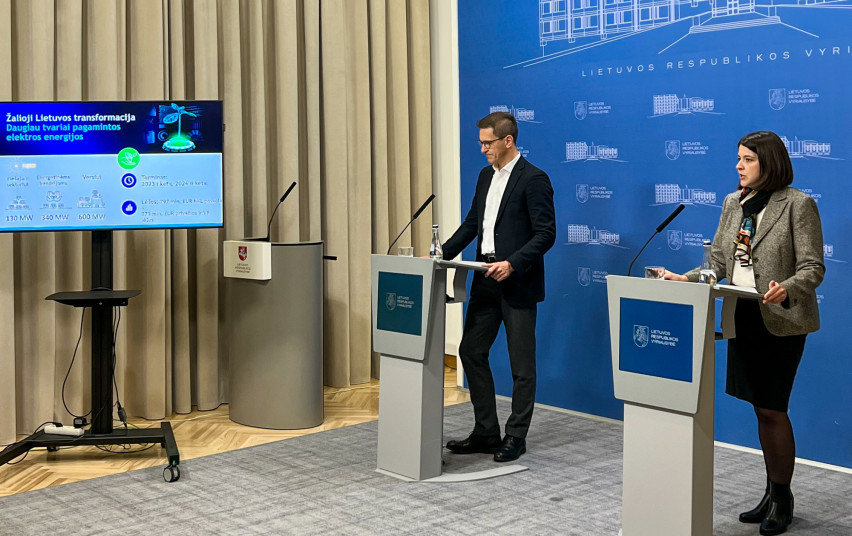
Minister of Finance Gintarė Skaistė together with Minister of Energy Dainius Kreivys presented the supplemented draft plan “New Generation Lithuania” (NGL) which foresees additional investment of about EUR 1 billion for energy independence, renewable energy sources (RES) and cyber security. The amendment to the NGL plan from today, 7 December, is presented for public consultation on e.pilietis platform.
“The need to supplement the plan “New Generation Lithuania” arose due to changes in geopolitical and international economic situation. At the moment, the biggest challenge is the pressure on energy prices and the lack of generation. We have long known that Russia is an unreliable partner, it was reaffirmed by the aggressor’s gas market manipulations, therefore, Lithuania started its path towards energy independence much earlier than the rest of Europe. However, the process has not yet been completed — we have to produce more electricity from renewable sources in Lithuania, thus guaranteeing people not only clean energy, but also lower bills, states Minister of Finance G. Skaistė. – At the same time, it is particularly important in this context to combat the spread of Russia’s disinformation in Lithuania and the ongoing attacks in the digital space, therefore, we update the plan “New Generation Lithuania” with a strong focus on cyber security “.
“In particular, I would like to draw your attention to the measures envisaged for energy communities. The transformation of the energy sector, if carried out disorderly, would benefit those with the greatest economic power. Our goal is that the benefits of the transformation of the sector reach every person, especially those experiencing energy poverty “, noted Minister of Energy Dainius Kreivys.
Additional investment for priority areas
The supplemented NGL plan aims to achieve ambitious goals, for the achievement of which more than EUR 1 billion is planned to be allocated through the borrowing instrument and funds under the REPowerEU initiative.
More sustainably produced electricity
Russia’s war against Ukraine has fundamentally disrupted the world’s energy system. Since local electricity generation in Lithuania ensures only about a third of the country’s electricity demand, Lithuania accelerates investment in electricity production from renewable sources.
Already next year, additional subsidies and loans will be created for energy communities, public sector and businesses to stimulate investment in new electricity generation capacities. The total amount of investment, including public and private funds, should amount to EUR 1 billion. At national level, this will help generate an additional 1 GW of green electricity, also will reduce energy poverty, budget expenditure for public electricity bills and will reduce electricity prices for businesses.
Modelling of energy changes
In the studies carried out on the transition to 100 % RES indicates that the growth of the RES share in total consumption of up to 80-90 % does not require excessive investment or new solutions, but the remaining 10-20 % are the most complex in both technical and investment terms. Therefore, Lithuania, which seeks to provide electricity fully from RES as soon as possible, needs to carry out the detailed and data-based modelling, which will include the plans for further development of RES.
The modelling of the Lithuanian energy system will include proposals for Lithuania to become a fully self-sufficient in electricity state as early as possible and to achieve 100 % of electricity consumed in Lithuania to be produced from RES.
Accelerated renovation of buildings
Planned additional investment of EUR 141.5 million in 2023-2026 to the owners of multi-apartment buildings for the achievement of not lower than energy performance class B for the renovated multi-apartment building with the compensation to pay 100 % of the costs of project preparation, construction technical maintenance and project administration and interest on the preferential credit granted in excess of 3 %.
Development of the Sustainable Mobility Fund for water transport
An additional EUR 9 million is being invested in the development of the Sustainable Mobility Fund to implement a pilot initiative that will enable the development of an alternative cleaner and cheaper way of freight transport on inland waterways, thus reducing pollution from heavy goods vehicles.
It is planned to use the invested funds for purchase of an electric ship, barge and electric crane to transport cargoes on inland waterways with zero emissions. After implementation of the pilot project, these activities s are expected to be further developed with private funds.
Strengthening the State’s cyber security
An additional investment of EUR 25 million will enable secure access to IT infrastructure, services and processes of public authorities. It will also promote public education, skills development and cooperation with private business.
Digital solutions will be implemented in the public sector, which will allow a smarter management of information on cyber incidents and e-crime, enable a faster prevention, deterring and investigation of cyber incidents and e-crime, encourage the Lithuanian society to be more critical about the risks in cyberspace, open potential development areas for strengthening cybersecurity, education, innovation, public and private sector cooperation.
Discussions with socio-economic partners
A supplemented draft NGL plan, before being formally submitted to the European Commission (EC) is presented for public consultations by 7 January. They are announced on e.pilietis.lt platform and will last for one month. In addition, individual ministries have already organised or will organise more detailed discussions on the new measures they have proposed. All partners and stakeholders are invited to participate actively and submit their proposals.
Following discussions in the EC, the supplement of the plan is expected to be approved in May 2023.
Last updated: 13-02-2023
Related news:
Minister of Finance met with the Ambassador of Ireland to Lithuania