

Students who wrote theses on public finances awarded
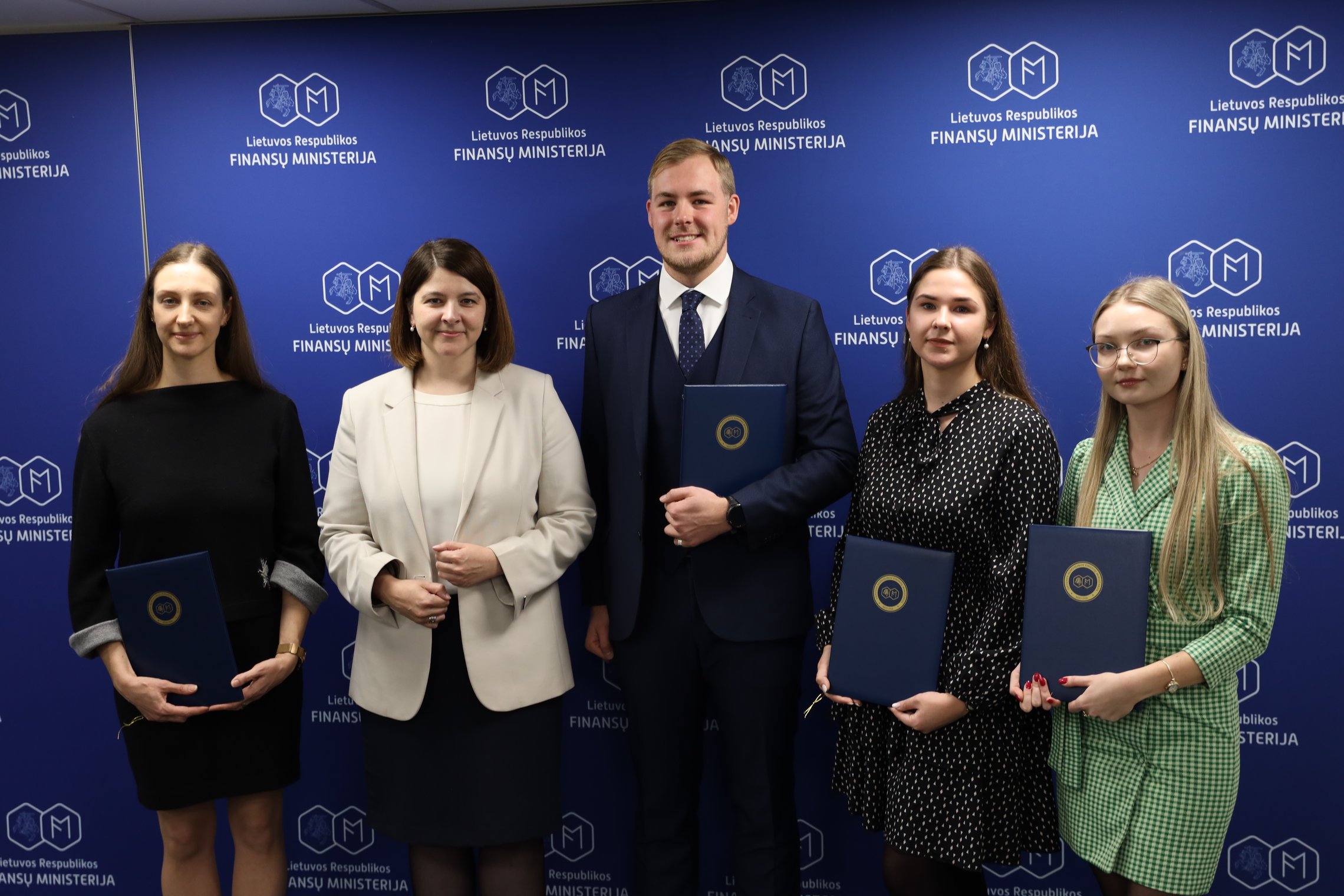
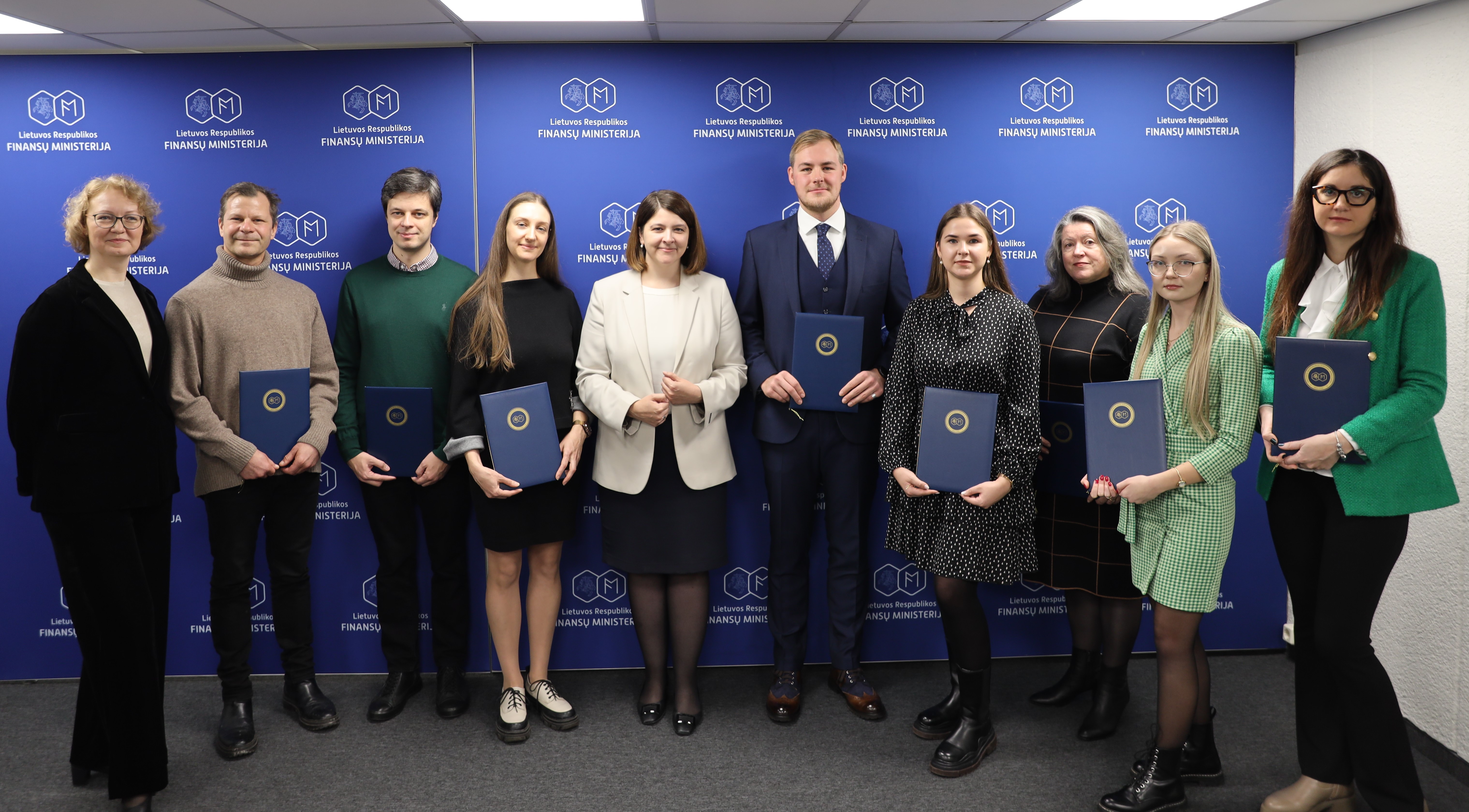
The students who were the winners in the thesis competition organized by the Ministry of Finance and their supervisors were awarded cash prizes. The students who submitted their final theses on the topics of public finances to the competition and won examined the topics of financial stability, the impact of public finances on sustainable development or economic growth, which reflected the current issues and trends of public finance management.
"We are pleased with the interest of this year's contestants and the quality of their research. The competition, organized for the second time, showed that Lithuanian higher education institutions educate future public finance professionals who can contribute to the creation of a more sustainable national economy and strengthening of public finances through their research. We hope that this competition will continue to encourage students to analyse public finance management processes in Lithuania, while contributing to the efficiency of fund management and benefit to society", Minister of Finance Gintarė Skaistė says.
The following students and their supervisors were awarded by the Ministry of Finance:
1st place in the Master's thesis category - Vytautė Karpienė, ISM University of Management and Economics. The topic of the thesis is "Financial Stability of Municipalities in Lithuania and How It Is Influenced by European Union Funding", the Supervisor is doc. Dr. Pijus Krūminas.
2nd place in the Master's thesis category - Tautvydas Klivickas, ISM University of Management and Economics. The topic of the thesis is "The impact of European Union Investments on Green Job Creation", the Supervisor is doc. Dr. Pijus Krūminas.
1st place in the Bachelor’s thesis category - Danas Zakarevičius, Vilnius University. The topic of the thesis is "State Budget Appropriations and State Debt in EU Countries - Good Practices and Proposals for Lithuania", the Supervisor is prof. Dr. Vincentas Rolandas Giedraitis.
2nd place in the Bachelor’s thesis category - Dovilė Kubiliūtė, Kaunas University of Technology. The topic of the thesis is "Analysis of Municipal Revenue and Expenditure and the Study of the Relationship with Quality of Life Indicators", the Supervisor is Lecturer Violeta Mykolaitienė.
1st place in the professional Bachelor’s thesis category - Rugilė Tamulytė, Vilnius University of Applied Sciences (Vilniaus kolegija). The topic of the thesis is "Assessment of the Impact of the European Union Financial Support on the National Economy", the Supervisor is Assoc. Dr. Alina Kvietkauskienė.
Students of higher education institutions (universities and colleges) who have defended university bachelor's, professional bachelor's or master's theses, which examine the following public finance topics: the impact of foreign direct investments on the Lithuanian economy; the expediency, efficiency, and benefits of state support or European Union support for the economy and society; influence of public finances on sustainable development in EU countries, assessment of state debt sustainability; municipal financial management, link with quality of life indicators, could participate in the competition.
The winners of the competition were to share the prize pool of cash prizes equal to 9 AW (average wages) of the current year. A total of 6 authors of theses - 2 Master's, 2 Bachelor's, and 2 professional Bachelor's theses and their supervisors - were scheduled to be awarded cash prizes. In each category, a 2 AW cash prize was awarded for 1st place, 1 AW cash prize was awarded for 2nd place (70% of the cash prize is awarded to the student, 30% to the supervisor).
Students' theses were evaluated according to the following criteria: compliance of the final thesis with the competition topic; use of data published on the website www.lietuvosfinansai.lt in the thesis; relevance and novelty of research, practical applicability of conclusions; the structure of the thesis, the quality of the research data analysis used in it, literature; validity of conclusions and proposals. The theses were evaluated by the commission established by the Order of the Minister of Finance.
It is planned that a similar competition of theses on public finances will be organized by the Ministry of Finance annually.
About students' final theses:
In her thesis, V. Karpienė examined the financial stability of the Lithuanian municipalities and the effect of the European Union (EU) structural funds and State budget funds on it. In the study, changes in various financial stability indicators in municipalities over the last 10 years were evaluated. The results showed that while EU funds are an important source of external funding, they can also lead to over-dependence and the risk of budgetary volatility. The author emphasizes the importance of strategic planning and the need to strengthen risk management in municipalities in order to ensure sustainable economic development and resilience to external factors.
In his final thesis, T. Klivickas examined the impact of EU investments on the creation of green jobs in various EU countries, paying special attention to the regions of Central and Eastern Europe. The results of the study did not show a link between EU investment and a significant increase in green job creation. In addition, it was not found that EU investments would have a greater impact on the creation of green jobs in Central and Eastern European countries compared to other EU countries. The author found that research and development spending and the total number of employees in the country had an impact on the creation of green jobs. Thus, in order to increase the creation of green jobs, attention should be paid not only to direct investments in green industries, but also to other factors that can promote the green transformation in the EU.
In his thesis, D. Zakarevičius aimed to analyse the impact of the State budget appropriations and debt on economic growth, using data from 27 EU countries from 2002 to 2022. The study found that the State budget appropriations for general state services, defence, economy, housing and public utilities, health and education have a positive effect on GDP growth, therefore, in order to stimulate the economy, it is suggested to pay attention to spending in these areas. It was established that the state debt can have a negative impact on GDP growth, and if it exceeds a 5% threshold of the state debt growth, a negative effect on the economy is manifested. Therefore, in order to avoid sudden jumps in the growth of state debt, it is proposed to follow a cautious fiscal policy.
D. Kubiliūtė's thesis highlighted the importance of municipal expenditure for local quality of life, especially in resort municipalities, where, according to the results of the study, the quality of life is the highest due to high expenses per capita. The analysis carried out in the research showed a strong relationship between the amount of municipal expenses and quality of life indicators, therefore, it is likely that properly planned municipal expenditure can contribute to a better quality of life for residents.
In her thesis, R. Tamulytė delved into how EU financial support can contribute to the growth of Lithuania's economy and what are the main challenges for the effective use of this support. The performed analysis showed that EU financial support has a positive effect on the national economy (a positive effect was determined for six out of nine examined macroeconomic indicators). The author presented recommendations on the use of EU financial support, emphasizing that the distribution of EU financial support funds should be focused on long-term strategic goals, and the received funds should be purposefully distributed to achieve those goals.
About website lietuvosfinansai.lt
The website lietuvosfinansai.lt managed by the Ministry of Finance is an important tool for transparent management of public finances and an opportunity for the public to better understand public finances. Here you can find answers to many questions relevant to the public. How much taxes and other revenue are collected in the national budget and where are these funds spent? How much are the country's assets worth and what are the liabilities? How much do state budgetary institutions spend on purchased goods or received services and who do they pay for them? All this and more can be found on this website.
The website contains the data on the implementation of the State, Municipal, Sodra, Compulsory Health Insurance Funds budgets, detailed payments to suppliers of goods and services, financial reports and other data since 2015. It also provides a unique opportunity to analyse the activities of municipalities: their revenue, expenditure, financial statement data and quality of life indicators. In addition, it is possible to analyse the data of municipalities' independent revenue and expenditure gaps.
Last updated: 14-11-2024