

Vice-Minister of Finance Januš Kizenevič at Bloomberg debate: Lithuania deploys all possible financial means to strengthen defence
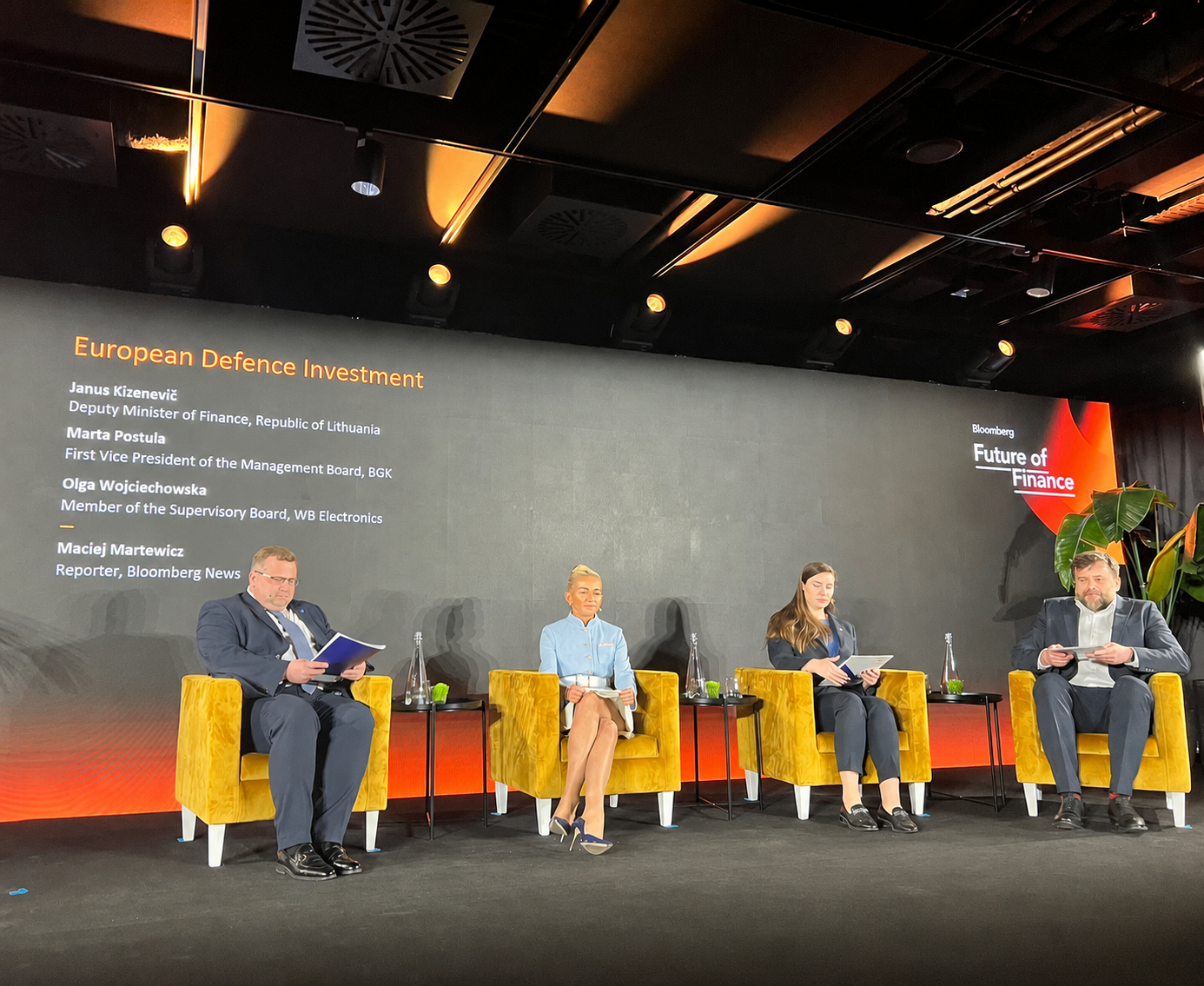
“The neighbourhood of the aggressor countries is a decisive factor in shaping Lithuania’s long-term defence policy. And this is not just our problem – NATO allies in the eastern flank systematically spend more on defence. Of course, this has fiscal implications that we need to address with a smart long-term sustainable strategy", Januš Kizenevič, Vice-Minister of Finance, said at the Bloomberg Conference on the Future of Finance in Central and Eastern Europe in Warsaw.
Presenting Lithuania's decisions to formulate a sustainable defence budget, the Vice-Minister underlined that Lithuania already allocates 5.38% of GDP to defence and intends to maintain defence spending between 5% and 5.5% of GDP per year until 2030.
According to the Vice-Minister, these are high costs that pose a number of challenges to fiscal policy, and several decisions have been taken: the establishment of a state-controlled defence industry holding with the aim of consolidating state capital, simplifying project management and ensuring a coordinated government approach to the development of the national defence industry and strengthening the National Development Bank ILTE, which aims to channel EUR 6 billion of investments into the Lithuanian economy over the next four years. Defence, security and energy independence are among ILTE's main investment priorities.
In addition, according to the Vice-Minister, active financial diplomacy has taken place, with international partners such as the European Investment Bank (EIB) and the Nordic Investment Bank (NIB) financing defence projects in Lithuania and providing technical assistance in structuring public-private partnership (PPP) schemes. These banks have already allocated EUR 1.5 billion to defence projects, and soon Lithuania will also sign a loan agreement of EUR 6.375 billion under the SAFE programme.
“With regard to the defence industry, SAFE facilitates participation in joint EU procurement and supports the integration of national suppliers into European defence value chains. This is an important step towards a more coordinated and interoperable European defence industrial base," J. Kizenevič said at the conference, adding that the main challenge now lies in the scale and technical complexity of the planned procurements, as well as the need to comply with strict EU eligibility, monitoring and reporting requirements.
The central element of the defence budget is the National Defence Fund, a dedicated fund created in 2024 to ensure sustainable additional resources for priority defence projects. It is forecast to reach around EUR 700 million in 2026. The Fund is financed from several sources of revenue: corporate income tax, excise duties on tobacco and alcohol, security contributions (formerly known as the solidarity contribution paid by banks), municipal allocations and voluntary contributions.
"All these measures ensure that key defence priorities, such as the reception of the German brigade in Lithuania and the expansion of the Lithuanian division, have secured transparent funding," the Vice-Minister of Finance stated.
"Our citizens are another pillar of the defence budget. They are also actively contributing to defence investments," J. Kizenevič stressed.
The Ministry of Finance is consistently introducing novelties in the distribution of defence bonds, and since 2024, when the distribution of defence bonds began, Lithuania has already placed 28 bond issues, attracting around EUR 362.6 million. Since February, defence bonds have been distributed continuously, offering a wider range of investment periods. The interest rate ceiling was abolished in April, allowing for a return of more than 2%, and bond issues with a maturity of more than one year were launched.
The Vice-Minister of Finance underlined that strengthening the EU's eastern borders is a shared European responsibility, and sufficient defence funding requires a combination of efforts at both national and European level. The eastern border of the EU should be a key priority in all future EU financial instruments, including the next Multiannual Financial Framework (MFF), to ensure coherent and long-term investment in security and resilience.
Finally, the Vice-Minister stressed that military mobility and the protection of critical infrastructure are crucial for defence and deterrence, requiring continued investment in dual-use infrastructure and active cooperation in projects such as Rail Baltica, which meet both civilian and military needs, and the development of new promising initiatives such as Eastern Flank Watch and European Dron Wall.
Last updated: 11-05-2026