

Vice-Minister of Finance M. Liutvinskas: "External Shocks Demonstrated the Benefits of Membership in the Euro Area"
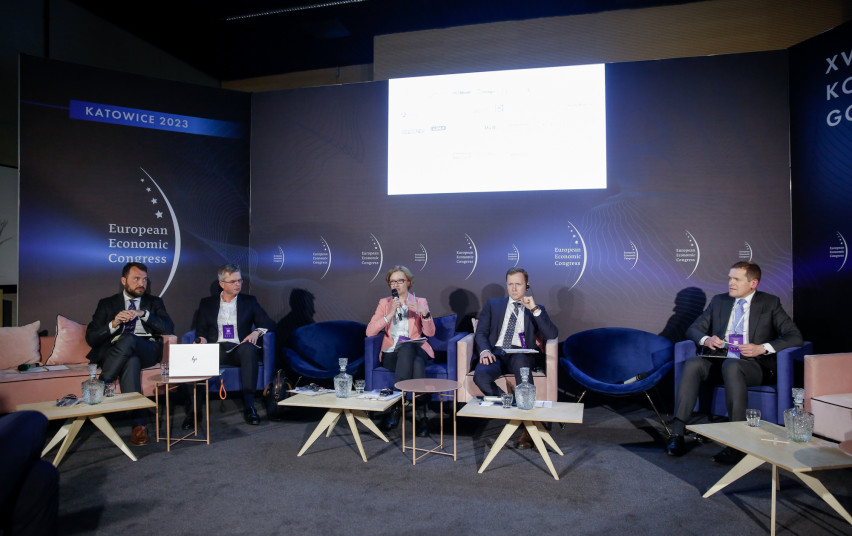
Membership in the euro area brought benefits to the Lithuanian economy and deepened the country's European integration. In the context of the upheavals of recent years – from the COVID-19 pandemic to russia's war against Ukraine and the accompanying spike in energy prices – Lithuania had the opportunity to see the benefits of membership in the euro area. Being part of the single currency area helped to mitigate the negative impact of shocks on the economy and public finances and to maintain confidence in the eyes of investors. This was emphasized by Vice-Minister of Finance M. Liutvinskas at the European Economic Congress in Katowice (Poland).
"Being a small, open and exporting economy, joining the euro area was a logical and rational decision for Lithuania, which strengthened the growth of the country's economy, stimulated faster export growth and eliminated the exchange rate risk. In addition, being under the umbrella of the European Central Bank helped Lithuania more easily withstand the shocks of the pandemic and the war in Ukraine, enabling the necessary fiscal response and at the same time maintaining confidence in the eyes of the markets," stated M. Liutvinskas.
Thanks to the membership in the euro area and the decisions of the European Central Bank (ECB), Lithuania maintained favourable borrowing conditions during the COVID-19 pandemic, which created the conditions to stimulate the economy on a large scale, providing support to affected employees and businesses. Being a part of the euro area also provided additional space for the Government to respond to the negative impact of the war in Ukraine on the Lithuanian and EU economies by providing support measures for residents and businesses.
During the discussion, M. Liutvinskas also emphasized that the membership in the euro area also has an important geopolitical element – having joined the single currency area in 2015 Lithuania further deepened its integration into EU structures. This is especially relevant in the context of russia's war against Ukraine, as geopolitical risks and uncertainty have increased.
The annual European Economic Congress held in Katowice, is one of the largest events of this kind, attracting experts from various fields, policy makers and business representatives. The 15th European Economic Congress focuses on the changing geopolitical situation, the russian war in Ukraine and the resulting crises, the transformation of the energy sector and independence from russian fossil fuels, as well as new opportunities in the economy, digitalization, etc.
Last updated: 03-05-2023