

Vice-Minister of Finance M. Liutvinskas: “Revised EU Fiscal Rules Need to Be Sound, Ensure the Sustainability of Public Finance and Leave Space for Necessary Investment“
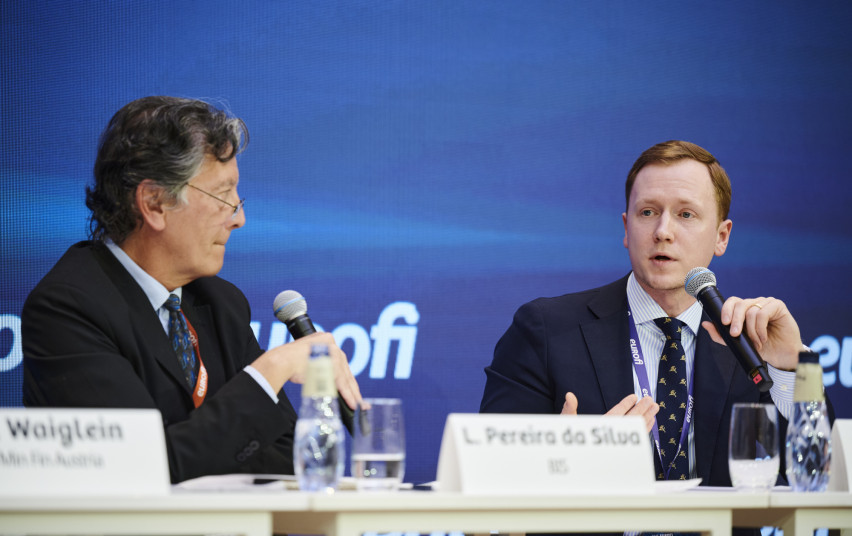
Vice-Minister of Finance Mindaugas Liutvinskas participating in the Eurofi Financial Forum discussion in Stockholm stated that ongoing review of the European Union (EU) fiscal rules must ensure more effective compliance with the rules, strengthen the sustainability of public finance of the countries and respond to the changed geopolitical situation – including the need to invest in the green transformation and strengthening of defence capabilities. The green transition will require huge resources over the next decade, so it is important to mobilise also the private sector funds for this purpose.
“In the process of reviewing the EU fiscal rules, we have consistently taken the view that the rules must be sound, both in the eyes of the countries and markets, and improve the sustainability of general government finance, especially in the countries facing high debt issues. At the same time, it is important to foresee adequate incentives for investment that enhances growth potential and strengthens fiscal sustainability. Nor can we ignore the geopolitical context – in the face of the russian war against Ukraine, the need to mobilise significant funds for the green transition and strengthening of defence capabilities is obvious. The fiscal rules should provide the necessary flexibility for this, especially in the countries with fiscal space for that “, – said M. Liutvinskas.
According to the Vice-Minister, the revised framework of fiscal rules should allow for more flexibility for countries to finance the necessary investment and structural reforms, while ensuring that public finance remains sustainable. In the discussions on the review of the rules, it is important to agree on safeguards to ensure that additional flexibility is not misused. Transparency of the whole process and equal treatment of the countries are of paramount importance in this regard.
During the discussions, Vice-Minister M. Liutvinskas also noted that public funds alone would not be sufficient to implement the green transformation – private investment must also be attracted. By 2030, green investment needs to meet greenhouse gas (GHG) emission reduction targets amount to about EUR 14 billion. Where, about EUR 10 billion is planned to be financed from the public sector, i.e. from EU and national funds, while the rest is expected to be mobilised from the private sector. For example, calls of EUR 1.14 billion directly for the realisation of the green transition in Lithuania are already planned for 2023.
In this context, the Ministry of Finance, together with policy makers in different areas, has prepared an action plan for the development of green finance, the aim of which is to create an ecosystem combining the public and private sectors that would help mobilise the necessary additional investment for Lithuania’s green transition by channelling private sector funds to sustainable projects and asset classes.
The plan foresees, among other measures, the creation of a knowledge and competence centre - the Green Finance Institute, which would advise companies and institutions on sustainable finance issues and play an important role as an intermediary between the public and private sectors. It is also envisaged to establish a centralised sustainable database with information available to policy makers, institutions, private sector representatives, the public, etc.
Last updated: 03-05-2023