

Vice-Minister of Finance V. Markevičienė: “In anti-money laundering it is important to build trust between institutions and market participants”
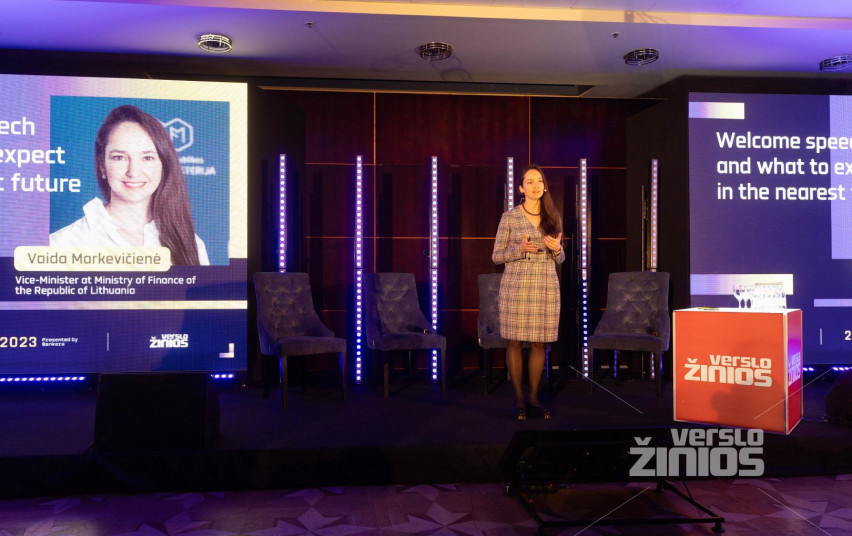
Lithuania in recent years has achieved a breakthrough in the Fintech sector, more and more innovative financial products and services emerge in the market – this opens up new opportunities, but at the same time creates new threats and risks. Therefore, it is necessary to build trust between competent authorities and market participants, and, in parallel, to raise public awareness of money laundering and terrorist financing threats. This was emphasised by Vice-Minister of Finance Vaida Markevičienė, who participated in the Baltic AML Forum 2023 organised by Verslo žinios and discussed with financial market professionals from 6 countries.
“The financial sector is undergoing an intense period of digital transformation, where money laundering and terrorist financing environment is constantly changing, criminals invoke state-of-the-art technologies to legalise illegally obtained funds. Therefore, Lithuanian financial market supervisory authorities must respond promptly and effectively to the changing environment, and the success largely depends on effective cooperation between regulatory and law enforcement authorities, public and private sectors and timely exchange of information”, says Ms. V. Markevičienė.
The Ministry strongly supports the initiative that would allow financial institutions to share information on clients for anti-money laundering and terrorist financing activities. Enabling financial institutions to share this type of information, suspicious activities and models, it would be easier to identify and perform more accurate risk assessments.
In fact, there is ongoing high level successful cooperation between the competent authorities in Lithuania – as a result, the Commission for the Coordination of Anti-Money Laundering and Terrorist Financing Policy established in 2022, which is headed by the Adviser to the Prime Minister. The Commission is responsible for national strategic objectives in this area, prevention and policy implementation.
.jpg)
The Ministry of Finance took proactive actions in the areas, where regulatory improvements were most needed. For example, already in 2022 Lithuania took regulatory measures in the crypto-asset service sector and tightened requirements for crypto service providers to mitigate the risks posed by the sector.
To implement the requirements of the Markets in Crypto-Assets Regulation (MiCA) and Transfer of Funds Regulation (TRF), the Ministry of Finance is preparing 7 draft amending laws. They will ensure a high level of protection for retail investors and better management of crypto-asset service providers’ money laundering and terrorist financing risks.
Last autumn, the Ministry together with the Centre of Excellence in Anti-Money Laundering and Mykolas Riomeris University initiated the Money Laundering and Terrorist Financing Prevention Certification Programme. This is the first such programme in the Baltic states with 102 graduated anti-money laundering specialists who will contribute to ensuring the risk management in the national financial sector.
Other relevant aspect, according to the Vice-Minister, is the establishment of the new EU Anti-Money Laundering Authority (AMLA) and selection of its headquarters. Lithuania aims for the AMLA Centre to be set up in Vilnius and has all the potential to become a centre of excellence in anti-money laundering in Europe.
Our country has accumulated institutional and regulatory experience that would be effectively used to address the challenges of money laundering and terrorist financing across the EU, also we are distinctive in the region for our highly qualified specialists.
Last updated: 17-10-2023