

Vice-Minister of Finance V. Markevičienė: “Lithuania is undeniable leader in the region for hundred per cent energy self-sufficiency”
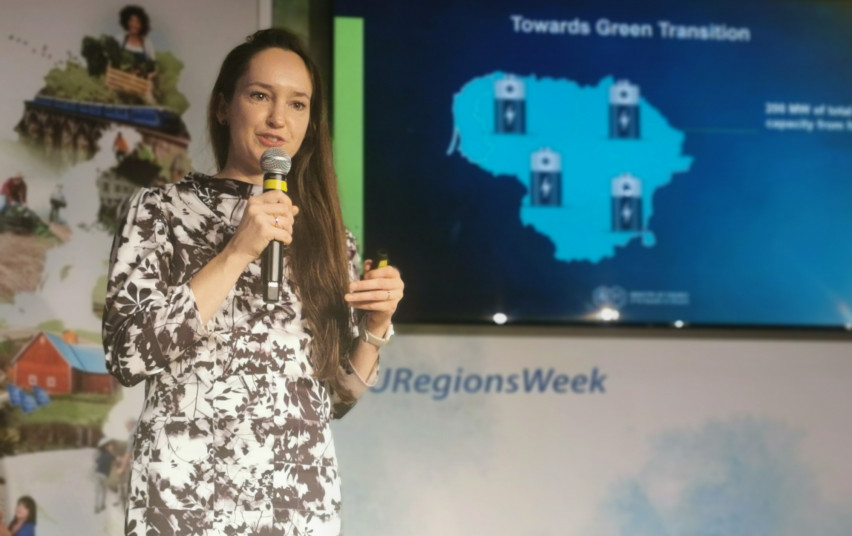
During the European Week of Regions and Cities in Brussels, Vice-Minister of Finance of Lithuania Vaida Markevičienė stressed that today Lithuania is completely independent from russian energy sources and a leader in the region, seeking hundred per cent energy independence.
“In the face of the war in Ukraine, Lithuania had to respond quickly to russian energy pressure and blackmail. Timely measures and investments focused on efficiency and results allow Lithuania not to import oil, gas or electricity from russia today. Lithuania does not pay russia a cent for its energy resources”, stressed Ms. V. Markevičienė.
As the Vice-Minister said, since 1990, we have seen russia as an unreliable partner who used energy dependence as a weight of political dominance. This is why we were the first fighters for energy independence in our region.
Last year, russia’s aggressive energy blackmail against countries dependent on russian gas proved more than ever that the decision taken by Lithuania eight years ago on the liquefied natural gas (LNG) ship-storage “Independence” was correct.
Ms. V. Markevičienė said that public and private sector projects are being implemented to stimulate private investment and support the level of investment in the country. A large part of the investment is channelled towards the green transition. The EU investment makes a significant contribution to the implementation of these projects. The plan “New Generation Lithuania” also laid a solid foundation for further investment in strengthening energy independence and more efficient use of renewable energy sources.
.jpg)
In addition, a significant part of the investment is channelled to the population as well. Increasing the energy independence of households also reduces dependence on changes in energy resource prices in the global market and significantly contributes to strengthening the country’s energy independence.
Ms. V. Markevičienė noted that at the moment we have more than 80 thousand prosumers and by 2030 we aim to have at least 30 % of our energy consumption produced by our citizens.
Moreover, in parallel with the development of solar energy, it is also necessary to encourage investment in wind farms. It is planned that the first offshore wind park in the Baltic states of about 700 MW, which will start operating in Lithuanian territorial waters near Palanga in 2028, could produce up to 3 TWh of green electricity per year, which would ensure up to a quarter of Lithuania’s electricity demand and reduce the country’s dependence on electricity imports.
According to the Vice-Minister, last year, the construction of four electricity storage devices of 200 megawatts in total of EUR 109 million was launched in Lithuania. This is one of the most important energy projects in terms of national security. If the country is disconnected from the BRELL ring before 2025, these batteries will be able to start supplying energy and renewing its supply throughout Lithuania in just a few seconds.
“Electricity storage devices will be useful for the development of renewable energy in Lithuania. This is a huge step towards both our energy security and synchronisation with continental Europe. In 2030, we will produce 100 % of our electricity in Lithuania”, said Ms. V. Markevičienė.
The European Week of Regions and Cities is the largest annual event dedicated to regional policy.During this annual four-day event, cities and regions demonstrate their capacity to ensure growth and job creation, to implement the European Union’s Cohesion Policy, they also show that local and regional levels are of vital importance to ensure good European governance.
Last updated: 17-10-2023