

In Vilnius, insights into why and how to achieve a single EU capital market
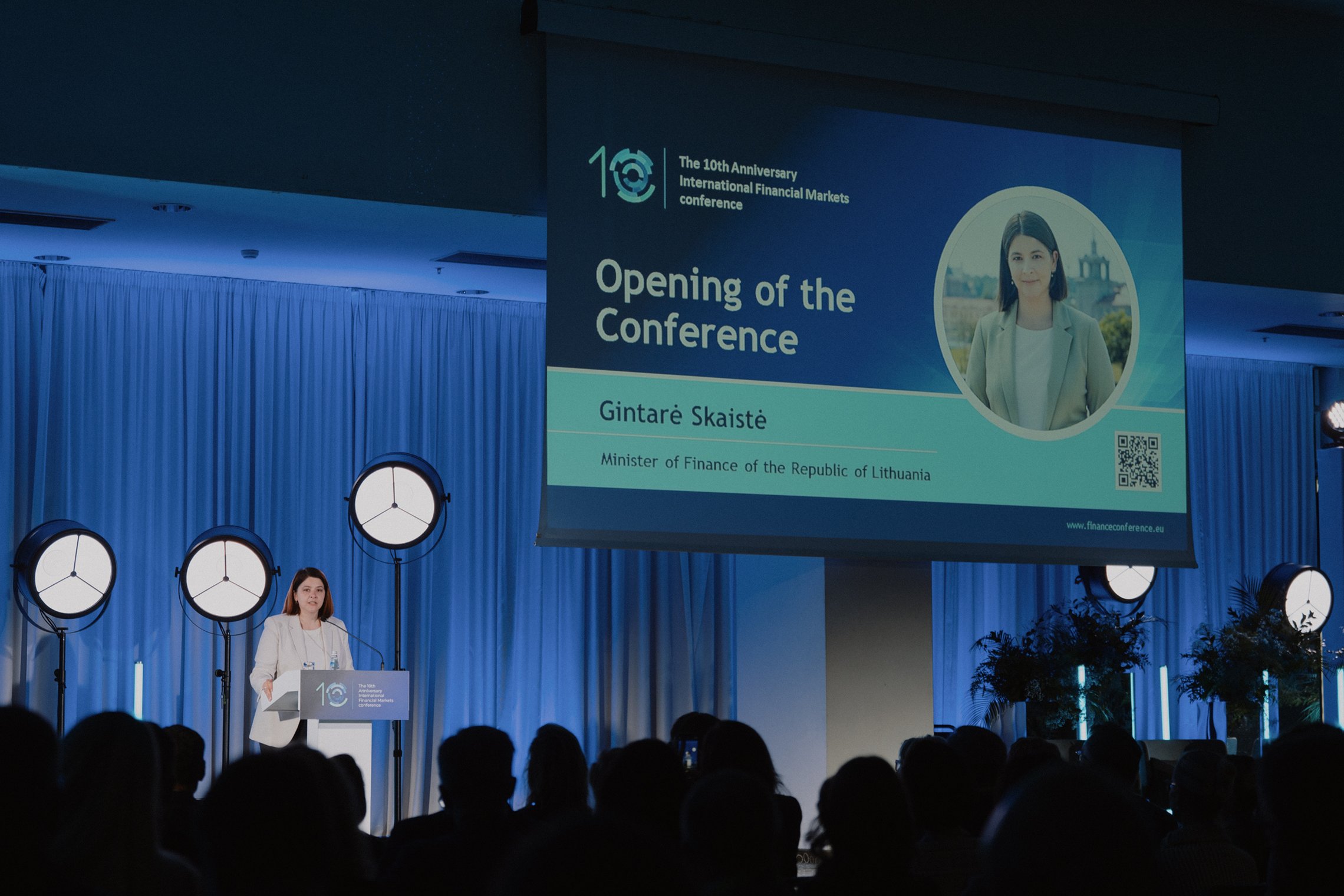
At the international conference in Vilnius, policy makers, experts and representatives of central banks analysed the reasons for the slackness of capital markets and the catalysts that would allow to accelerate the growth of these markets.
Fragmentation of capital markets in EU countries, lack of progress towards a Capital Markets Union and opportunities and tools to employ European investment capacity to strengthen the economies of both the Community as a whole and its individual members were the dominant topics at the 10th International Conference on Financial Markets.
“Now is a great opportunity to discuss the situation of capital markets, as the new political cycle begins not only in Lithuania, but also in the EU. The Capital Markets Union project is seen as an essential contribution to Europe's ambitious goals in strengthening the continent's competitiveness. In this context, the new European policy cycle is likely to advance towards a single European capital market. Meanwhile, close cooperation between the Baltic States could serve as an example of good practice in constructing a European model”, Minister of Finance of Lithuania Gintarė Skaistė stated.
“The fact that this conference is already held for the 10th time proves, I believe, that the development of capital markets is one of the long-term priorities for both Lithuanian institutions and market participants,” Ingrida Šimonytė, Prime Minister of Lithuania, noted.
According to her, as the EU faces competitiveness and geopolitical challenges, European financial markets need to improve access to finance for businesses, especially small and medium-sized enterprises, better financing opportunities for start-ups and innovative start-ups are needed, while it is important to reduce the fragmentation of capital markets and barriers to investment.
M.Draghi's ideas encourage change
Arminta Saladžienė, Moderator and Vice-President of Nasdaq for the European market, focused one of the discussions on trends in European and regional capital markets on the EU competitiveness report by Mario Draghi, former ECB President, published in mid-September. The former Italian Prime Minister says that the EU needs to inject EUR 800 billion in additional investment every year if it is to remain competitive on the global market. Directions include the green and digital transformation of the EU economy, security and defence, competitiveness and the EU’s strategic autonomy.
"We are probably all aware that such an objective cannot be achieved by public investment and banks alone. Capital markets must contribute to this by mobilising private investment, and in order to kick-start it, it is necessary to reduce fragmentation among the EU Member States. Nor should we get stuck on a single model of stimulating investment, such as tax incentives. A transparent investment environment and the development of interesting, simple and attractive investment instruments for the population should be fully operational”, G. Skaistė said.
Fragmentation of EU capital markets was also mentioned as an obstacle to the investment breakthrough by other participants of the discussion: Gediminas Šimkus, Chairman of the Board of the Bank of Lithuania; Madis Müller, Head of the Central Bank of Estonia; Mārtiņš Kazāks, Head of the Central Bank of Latvia; André Küsvek, President of the Nordic Investment Bank (NIB).
"The main reason why we do not yet have the Capital Markets Union in Europe is the different legal and regulatory environment. In order for the capital market to grow successfully, not only in the Nordic-Baltic region, but also in Europe as a whole, legal and regulatory differences need to be reduced. The Capital Markets Union is a fund and investment union. Properly invested funds can have a positive impact on growth and innovation in the euro area”, Gediminas Šimkus, Chairman of the Board of the Bank of Lithuania, noted.
Financial literacy is the key
At the international conference, the speakers representing Lithuania acknowledged that the population of our country owns EUR 23 billion, two-thirds of which are in current accounts, without any return even during the period of rising interest rates. How can people be encouraged to invest and thus contribute to strengthening the capital market?
"The answer is financial literacy. Our government has a plan to develop the financial literacy of society and its individual groups, and as these processes move on, I hope that simple, safe and transparent technological solutions from financial service providers will be offered to people. I am sure that investment will also be stimulated by the emergence of an investment account. Examples of currently understandable and attractive investment tools are government securities and the upcoming issuance of targeted defence bonds”, Minister G. Skaistė said.
Some of the most active investors in the world are Swedish population. NIB President A. Küüsvek agreed with the Minister that financial literacy is the key to solving many of the puzzles: “Young persons are better at any education, so if children were already involved in investment processes, it would be easy, interesting and simple for them. This creates a culture of understanding risk. However, going back to the European Capital Markets Union, I have to admit that it will be much more difficult than completing the Banking Union, as we start with the first steps.”
The 10th International Financial Markets Conference in Vilnius was organized by the Ministry of Finance, the Bank of Lithuania, and the Association of Lithuanian Banks.
Last updated: 14-10-2024